
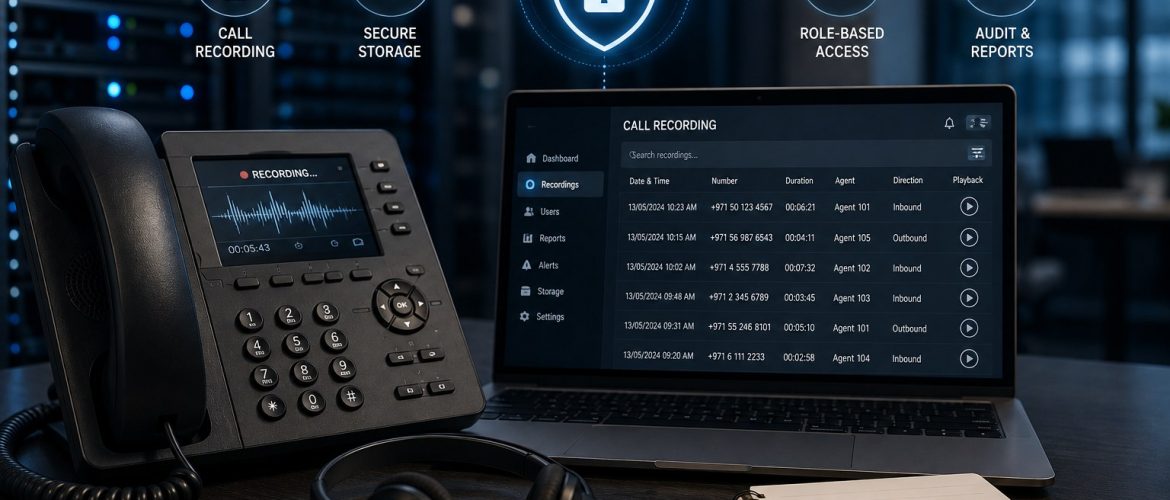
Phone conversations continue to play an important role in business communication. Customer enquiries, sales discussions, approvals, complaints, financial conversations and operational instructions are frequently handled over the phone.
When important information is exchanged verbally, businesses may need an accurate and secure way to maintain a record of what was discussed.
This is where Secure Call Recording becomes valuable.
A professional recording solution can capture business conversations, store them securely and allow authorised users to retrieve recordings when necessary. These capabilities can support compliance procedures, quality monitoring, dispute resolution, employee training and better communication management.
MAK Group provides Voice Recording System solutions designed around secure recording, management, controlled access and integration with business communication environments.
What Is Secure Call Recording?
Secure Call Recording is the process of capturing telephone or voice conversations and storing them within a controlled environment where access, retention and retrieval can be managed.
Recording a conversation is only one part of the process.
A complete business solution should also consider:
- Secure storage
- User access permissions
- Recording retrieval
- Search capabilities
- Retention policies
- Backup
- Audit trails
- System administration
- Integration with existing communication platforms
The objective is to ensure recordings remain useful while protecting sensitive business and customer information.
Why Businesses Record Calls
Different organisations have different reasons for recording business conversations.
For some businesses, recordings are primarily used for customer service monitoring.
Others may require records to support internal governance, quality assurance or industry-specific regulatory obligations.
Common applications include:
- Customer service
- Financial services
- Sales departments
- Contact centres
- Healthcare organisations
- Logistics operations
- Trading environments
- Insurance companies
- Technical support teams
- Corporate communication departments
MAK Group positions its voice recording solutions for communication-intensive industries including banking, healthcare, logistics and customer service, with features focused on secure recording and management.
Secure Call Recording and Compliance
Compliance is one of the most important considerations when implementing call recording.
Businesses should first identify why conversations need to be recorded, which users should be recorded, how long recordings should remain available and who should be permitted to access them.
The UAE’s federal personal data protection framework establishes requirements relating to the processing and protection of personal data. Organisations implementing recording technologies should therefore assess their specific obligations and obtain appropriate legal or compliance advice rather than assuming that one recording policy is suitable for every organisation.
For organisations with significant compliance requirements, MAK Group also provides dedicated Compliance Recording solutions designed for enterprises and financial institutions requiring continuous voice logging, monitoring and risk management capabilities.
Encryption and Recording Security
A recorded conversation may contain information that should not be available to every employee.
Depending on the organisation, recordings might include:
- Customer contact information
- Financial discussions
- Pricing
- Account information
- Complaint details
- Business negotiations
- Internal instructions
- Commercially sensitive information
Secure recording therefore requires more than storing audio files in a folder.
Businesses should consider controls that protect recordings from unauthorised access, modification or inappropriate distribution.
MAK Group’s voice recording offering includes security-oriented functionality such as access controls, encryption, management dashboards and recording administration.
Role-Based Access Control
Not every employee needs access to every recording.
A customer service manager may need access to recordings from a specific department.
A compliance officer may require access to a larger group of recordings.
Individual agents may only need access to limited information.
Role-based access can help organisations define which users are permitted to:
- Search recordings
- Listen to conversations
- Download recordings
- Delete recordings
- Export data
- View reports
- Change retention settings
- Manage other users
Restricting access can reduce unnecessary exposure of sensitive communication.
Call Recording Retention Policies
Keeping every recording indefinitely is not necessarily the right approach.
Organisations should develop a retention strategy based on business requirements, legal obligations, contractual responsibilities and internal policies.
A retention policy should define:
- Which calls should be recorded
- How long recordings should be retained
- When recordings should be archived
- When recordings should be deleted
- Which departments require different retention periods
- Who can approve exceptions
UAE data protection requirements include principles related to processing, storage and protecting personal data, making retention planning an important governance consideration.
Secure Call Recording for Customer Service
Customer service teams deal with large numbers of conversations.
Managers cannot listen to every live customer interaction.
Recorded conversations make it possible to review selected calls later and identify areas where service quality can be improved.
Managers may review:
- Greeting quality
- Product knowledge
- Response accuracy
- Complaint handling
- Communication clarity
- Call structure
- Resolution quality
- Escalation procedures
Recordings can provide a more objective basis for evaluating communication quality than relying only on individual recollection.
Contact centres may also combine recording with routing, monitoring and analytics tools. MAK Group’s Contact Center Business solutions include capabilities such as call recording, monitoring and agent performance tools within broader customer communication environments.
Using Recorded Calls for Employee Training
Recorded conversations can become useful training materials when they are handled appropriately.
Managers can identify examples of successful conversations and use them to demonstrate good communication practices.
Training may cover:
- Handling difficult customers
- Explaining products clearly
- Responding to objections
- Managing complaints
- Following approved processes
- Improving call opening and closing
- Identifying missed opportunities
Instead of relying entirely on theoretical examples, teams can learn from actual communication scenarios within the organisation.
Resolving Customer Disputes
Disagreements can occur regarding what was discussed during a telephone conversation.
A customer may remember one interpretation while an employee remembers another.
A properly maintained recording can help authorised personnel review the conversation and determine what information was actually exchanged.
This can be helpful when reviewing:
- Prices
- Delivery dates
- Product specifications
- Service commitments
- Appointment details
- Customer requests
- Cancellation instructions
- Approvals
Recording does not remove the need for good written documentation, but it can provide an additional source of information.
Secure Call Recording for Financial and Trading Environments
Financial and trading environments often have specialised communication requirements.
These environments may require resilient recording, auditability and integration with specialised voice systems.
MAK Group’s Trading Floor Solutions include support for secure call recording across dealer board and PBX environments, while its compliance recording services are designed around regulatory, quality-monitoring and risk-management needs.
Searching and Retrieving Recordings
Recording thousands of calls is not useful if finding a particular conversation takes hours.
A professional recording platform should make retrieval practical.
Depending on the solution, recordings may be searched using information such as:
- Date
- Time
- User
- Extension
- Telephone number
- Department
- Call direction
- Tag
- Reference
Search functionality can become particularly important for businesses handling large call volumes.
Integration With Existing Phone Systems
Many businesses already operate PBX, VoIP or contact-centre environments.
Installing Secure Call Recording should therefore begin with an assessment of the existing communication infrastructure.
Important questions include:
- What telephone platform is currently used?
- How many users require recording?
- Are calls made through traditional telephony, VoIP or Microsoft Teams?
- Is recording required for every call?
- Where should recordings be stored?
- How long should recordings be retained?
- Who should have access?
- Is integration with other systems required?
MAK Group states that its voice recording systems can integrate with existing PBX and VoIP infrastructure, while its broader compliance recording solutions support integration with communication and business platforms.
Cloud and On-Premise Considerations
Businesses may encounter both cloud-based and locally deployed recording architectures.
The appropriate approach depends on requirements such as:
- Existing infrastructure
- Security policies
- Data governance
- Storage requirements
- Remote access
- Scalability
- Business continuity
- IT management capabilities
The decision should be based on organisational requirements rather than selecting a deployment model simply because it is newer.
Planning a Secure Call Recording Deployment
A successful implementation should begin with requirements rather than equipment.
Step 1: Identify the Purpose
Determine why calls need to be recorded.
Possible objectives include compliance, customer service, quality assurance, training, dispute management or business continuity.
Step 2: Define Users
Identify which teams, departments and telephone numbers require recording.
Step 3: Review Existing Infrastructure
Understand the current PBX, VoIP, contact-centre or Microsoft Teams environment.
Step 4: Define Security Requirements
Determine who should have access to recordings and what administrative permissions are required.
Step 5: Create a Retention Policy
Define how recordings will be retained, archived and removed according to applicable requirements.
Step 6: Test Before Full Deployment
Run a controlled pilot to verify recording quality, retrieval, user permissions and system reliability.
Step 7: Train Administrators and Users
Employees responsible for managing the system should understand how recordings are stored, searched, accessed and protected.
Common Call Recording Mistakes
Recording Without a Clear Policy
Technology should support an established business purpose.
Organisations should define why they are recording calls before deployment.
Giving Too Many Users Access
Recording access should be limited to appropriate authorised personnel.
Ignoring Storage Requirements
Call volumes can create significant storage requirements over time.
Capacity planning should be completed before deployment.
No Retrieval Strategy
Recordings need to be searchable and manageable.
Ignoring Backup
Important recordings should be incorporated into appropriate continuity and backup planning.
Treating Compliance as Only a Technical Issue
Recording software can provide controls, but organisations remain responsible for policies, governance and appropriate use.
Frequently Asked Questions
What is Secure Call Recording?
Secure Call Recording captures business telephone conversations and stores them within a controlled system where authorised users can manage, retrieve and review recordings.
Why do businesses record calls?
Common reasons include customer service monitoring, training, dispute resolution, compliance, quality assurance and maintaining accurate communication records.
Can call recordings contain sensitive data?
Yes. Depending on the conversation, recordings may contain personal, financial or commercially sensitive information. Appropriate controls should therefore be applied.
How long should call recordings be kept?
There is no universal retention period suitable for every business. Organisations should determine retention based on their regulatory, legal, operational and contractual requirements.
Can call recording integrate with existing phone systems?
Professional recording solutions can support integration with various communication environments. Compatibility should be assessed before implementation.
Final Thoughts
Secure Call Recording can provide businesses with greater visibility and control over important voice communication.
However, effective call recording requires more than simply capturing audio.
Businesses should consider security, retention, user access, retrieval, integration, compliance requirements and ongoing system management.
For organisations requiring a structured recording environment, MAK Group provides Voice Recording Systems and Compliance Recording Solutions designed for business communication environments in the UAE.
Companies with customer-facing operations can also explore MAK Group’s Contact Center Business Solutions for integrated communication, monitoring and call-management capabilities.


No comments yet.